

You've got the ceremony script. You know the structure. But now you're staring at the page thinking: what do I actually say?
If you've been asked to officiate a wedding, the ceremony script tells you the order of events — but your officiant speech is the part that makes it personal. It's your voice, your words, the thing that turns a ceremony from a checklist into a moment people remember.
The good news: you don't need to be a poet or a public speaker. You just need a clear structure, a few personal details, and the confidence to say them out loud.
Here's everything you need to know.
What Is a Wedding Officiant Speech?
The officiant speech is everything you say during the ceremony in your own words. It's separate from the vows (that's the couple's job) and different from the full ceremony script (which includes stage directions, cues, and the couple's lines).
Your speech typically covers four things:
- The welcome — greeting the guests and setting the tone
- The couple's story — a short, personal section about who they are and why they're here
- Transitions — the lines that guide the ceremony from vows to rings to pronouncement
- The pronouncement — the declaration that makes it official
That's it. Four sections. In most ceremonies your own speaking time adds up to about 5 to 8 minutes, within a ceremony of roughly 15 minutes.
Officiating soon? Keep track of every step.
Get the free printable checklist for first-time officiants. It covers everything from getting ordained to signing the marriage license after the ceremony.
No spam. Unsubscribe anytime.
Part 1: The Welcome (Opening Words)
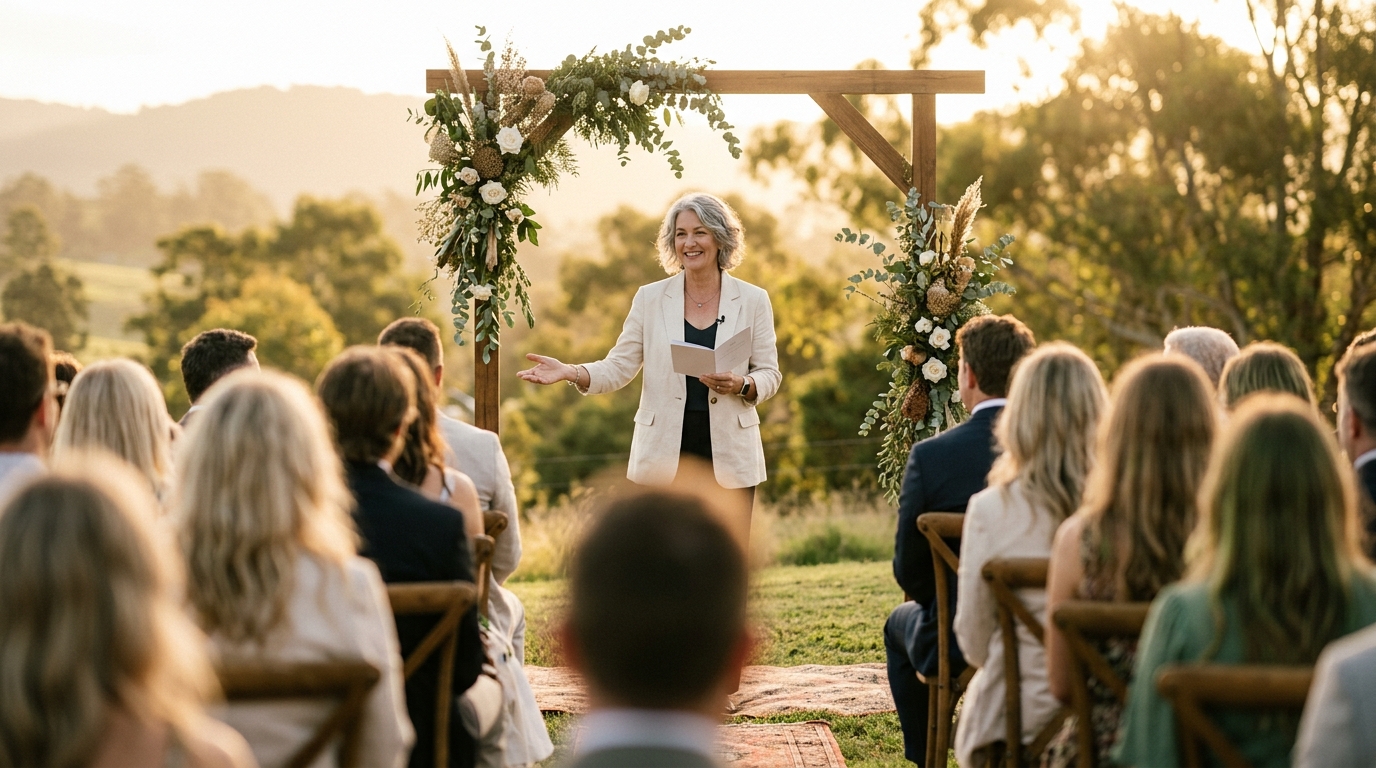
The welcome is the first thing you say after the processional ends and the couple is standing in front of you. It does three jobs: greets the guests, names why everyone is here, and sets the emotional tone for the ceremony.
Here's the thing most first-time officiants get wrong: they default to "Dearly beloved, we are gathered here today…" That line works for traditional ceremonies, but it's not your only option — and for many couples, it's not the right one.
Choose your opening words based on the couple's style:
Classic opening
"Dearly beloved, we are gathered here today to witness and celebrate the union of [Name] and [Name] in marriage. This is a moment they have looked forward to for a long time, and they are so grateful to share it with each of you."
Modern opening
"Good afternoon, everyone — and welcome. If you're here, it's because [Name] and [Name] love you, and your presence today means more to them than you probably realize. So thank you for showing up."
Lighthearted opening
"Hi, everyone. I'm [Your Name], and I have the best job here today — I get to marry these two. No pressure."
All three openings work. The right one depends on the couple, the venue, and the vibe they want. Ask them: Do you want your ceremony to feel classic, warm and personal, or relaxed and fun? Their answer tells you which direction to go.
Keep the welcome to 1–2 minutes max. Welcome the guests, name the couple, set the tone — then move on.
Part 2: The Couple's Story
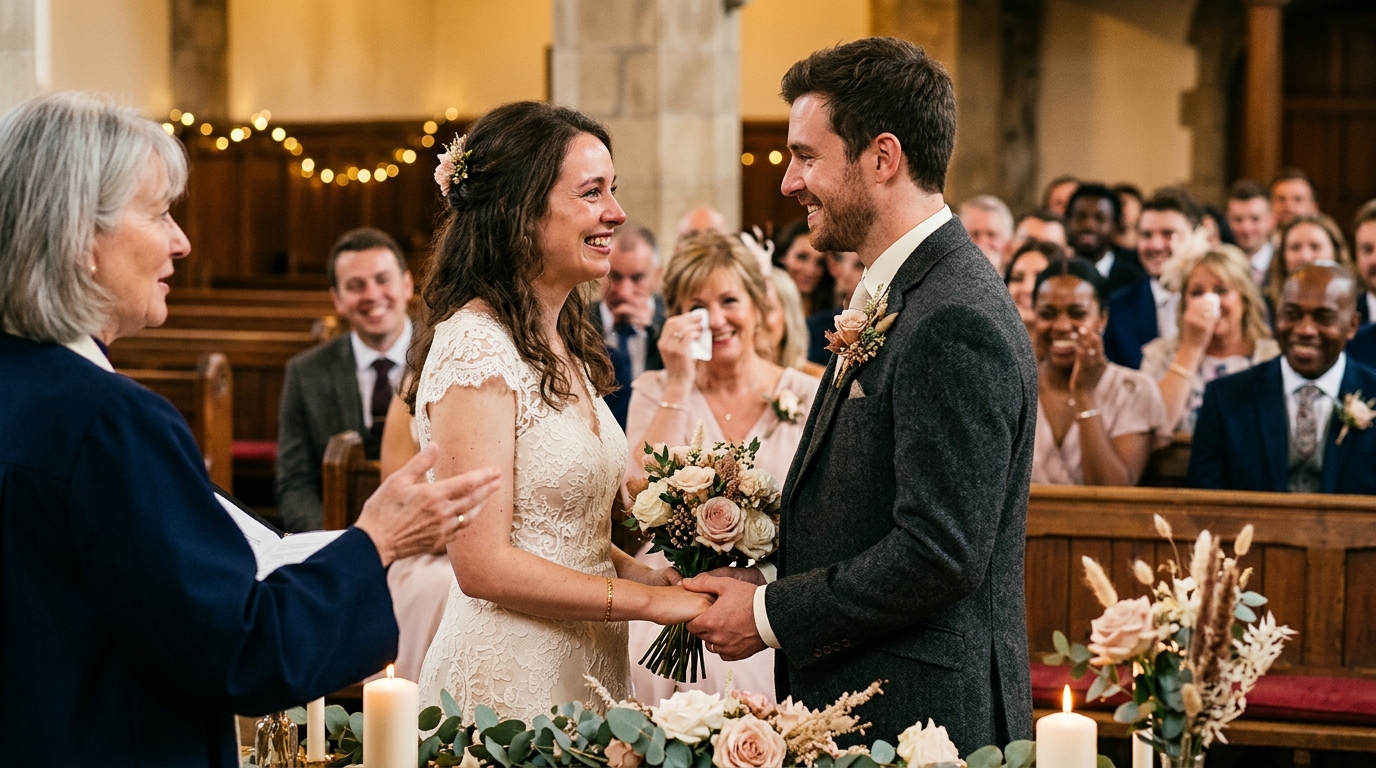
This is the heart of your speech and the part that makes a ceremony feel personal rather than generic. It's a short section — 2 to 4 minutes — where you share something real about the couple: how they met, what makes their relationship work, or a moment that shows who they are together.
How to Gather Material
You're not going to make this up. Before the wedding, have a conversation with each partner separately (or together, if they prefer). Ask questions like:
- How did you two meet?
- When did you know this was the person?
- What's something your partner does that no one else sees?
- What's a challenge you faced together that made you stronger?
- Is there a moment or a story that captures your relationship?
Take notes. You're looking for one or two specific details — not a biography. The best couple stories are short, specific, and honest.
What a Good Couple's Story Sounds Like
"I asked [Name] when he knew [Name] was the one, and he said — without hesitation — it was the night their flight got canceled in Denver. No hotel, no plan, twelve hours in an airport terminal. He said most people would have been miserable. But [Name] bought a deck of cards, two overpriced sandwiches, and turned it into one of the best nights of his life. That's what [Name] does — she makes the ordinary feel like an adventure."
Notice what this does: it's specific (Denver airport), it's visual (deck of cards, sandwiches), and it says something real about who the person is. That's all you need.
What to Avoid
- Don't tell their whole life story. Pick one or two moments. That's enough.
- Don't include anything the couple hasn't approved. If in doubt, check.
- Don't use inside jokes no one else will get. The story should land for the whole room, not just the front row.
- Don't talk about exes, past relationships, or anything that could make anyone uncomfortable. This sounds obvious, but it happens more than you'd think.
Part 3: Transitions
Transitions are the short lines you say to move the ceremony from one section to the next. They're easy to overlook, but they matter — without them, the ceremony feels choppy and the guests don't know what's happening.
Here are the key transitions you'll need:
From your speech to the vows
"And now, the part everyone has been waiting for. [Name] and [Name] have written their own vows to each other. [Name], whenever you're ready."
Or a simpler version: "It's time for the promises. [Name], you're up first."
From the vows to the ring exchange
"Those were beautiful. Now, may I have the rings, please?"
Or: "Thank you both. Let's make it tangible — may I have the rings?"
From the ring exchange to the pronouncement
"With these rings and these vows, you've made your promises to each other in front of everyone who matters most to you."
You don't need to be clever here. Transitions just need to be clear and smooth.
Part 4: The Pronouncement
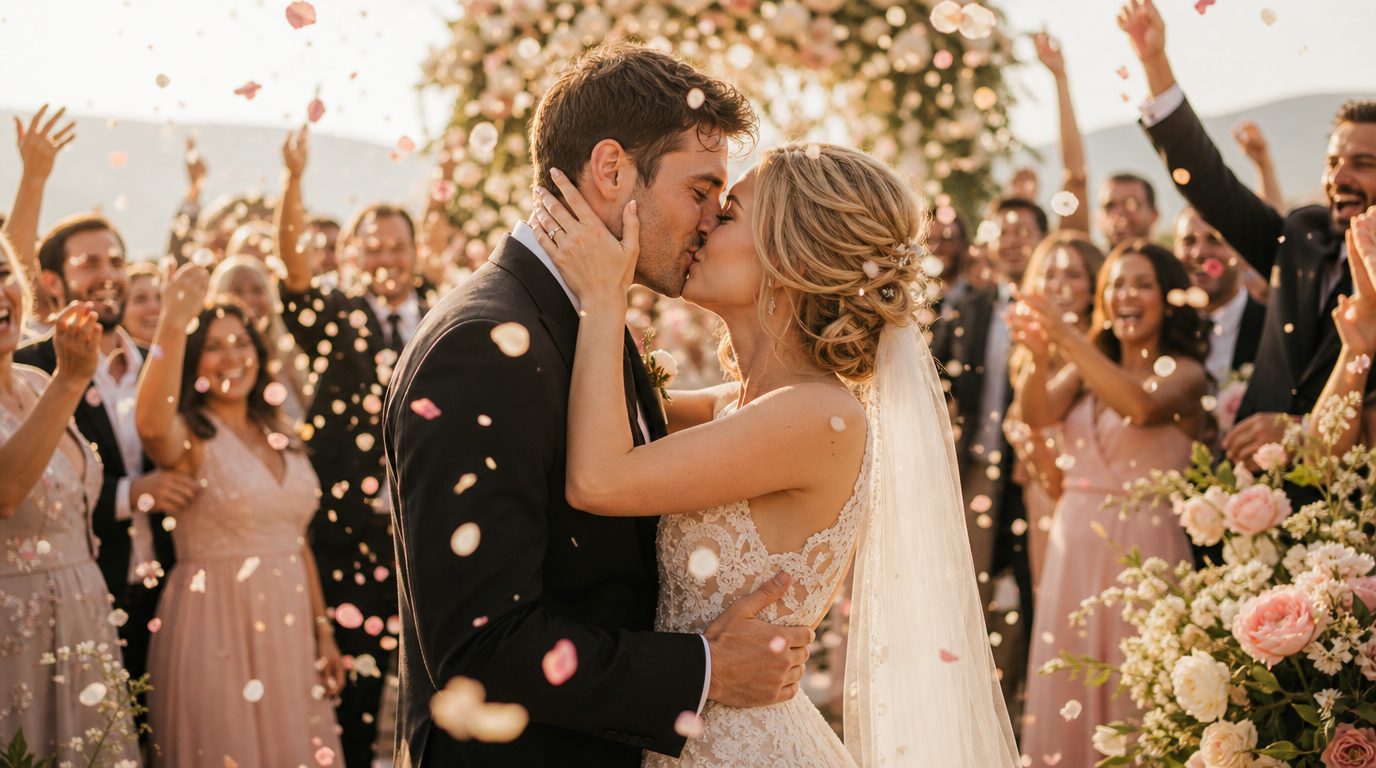
The pronouncement is the moment you officially declare them married. Few states prescribe exact wording, but this is the part that carries legal weight, so check your state's requirements before the day — some have specific rules about what must happen during the ceremony.
A common form is: "By the power vested in me by the state of [State], I now pronounce you…" Here are a few variations:
Classic pronouncement
"By the power vested in me by the state of [State], I am honored to pronounce you husband and wife. You may now kiss."
Modern pronouncement
"By the authority vested in me, and with the love and support of every person in this room, I am so happy to declare you officially married. Go ahead — kiss your person."
Short and sweet
"You're married. Kiss!"
Introducing the couple
"Ladies and gentlemen, it is my absolute pleasure to introduce to you — for the very first time — [Names]!"
Time this to the energy. Pause before the pronouncement. Let the room feel the weight of the moment. Then deliver it with warmth and confidence. This is the line everyone will remember.
Complete Officiant Speech Outline
Here's a clean outline you can use to write your own speech. Fill in each section and you'll have a complete, personalized officiant speech ready to deliver.
Welcome 1–2 min
- Greet the guests
- Name the couple
- Thank people for being there
- Set the tone (one or two sentences about love, marriage, or the day)
Couple's story 2–4 min
- One or two specific stories or details
- What makes their relationship special
- A genuine observation about who they are together
Transition to vows 15–30 sec
- Short bridge from your words to theirs
- Cue the first partner
Transition to rings 15–30 sec
- Acknowledge the vows
- Ask for the rings
- Brief ring introduction ("a symbol of…")
Pronouncement 30 sec–1 min
- The declaration
- "You may kiss"
- Introduction of the newlyweds
Your total speaking time: about 5–8 minutes
Want more examples?
How to Officiate a Wedding includes five complete ceremony scripts with every word the officiant says, plus ring exchange and pronouncement wording, vow templates and the legal requirements for all 50 states and D.C.
7 Tips for Delivering Your Speech
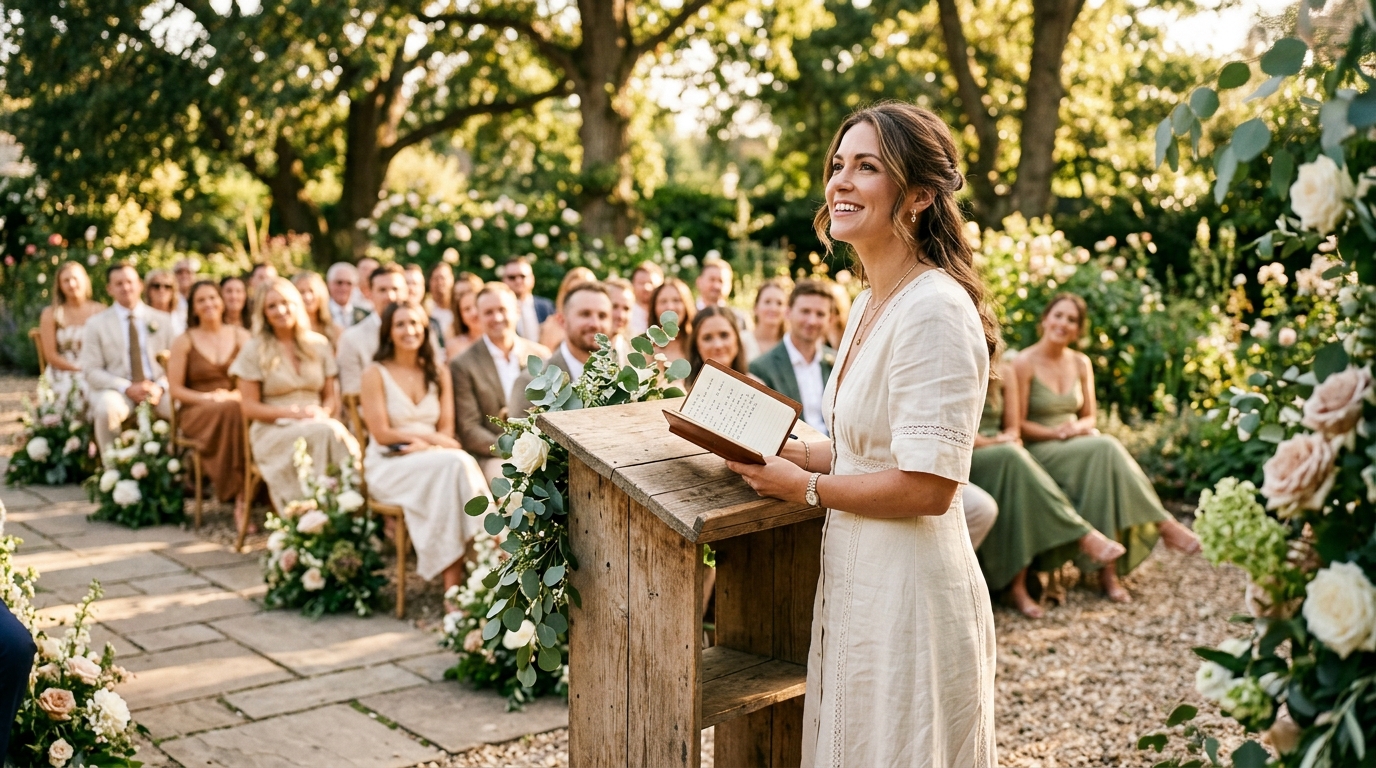
Writing the speech is half the job. Delivering it well is the other half. Here's what works:
- Practice out loud at least five times. Reading silently is not the same as speaking. You'll catch awkward phrases, pacing issues, and words that trip you up.
- Print it in large font (14pt+). You'll be nervous, your hands might shake, and you'll be reading in natural light (or candlelight). Make it easy on yourself. Double-spaced, printed on card stock or in a small binder.
- Don't memorize it. Having a printed copy is not a weakness — it's smart. Even professional speakers use notes. The goal is to be present, not to prove you have a good memory.
- Make eye contact. Look at the couple during the personal parts. Look at the guests during the welcome and pronouncement. Alternate between your notes and the room.
- Slow down. Nerves make you speed up. Consciously slow your pace. Pause between sections. Let the words land.
- Project your voice. If there's no microphone, speak louder than feels natural. The people in the back row need to hear you too. If there is a microphone, speak at a normal volume and stay close to it.
- Breathe. Before you start, take one slow breath. It calms your nerves and gives the room a moment to settle. You're not in a rush.
What to Do Next
You now know what a wedding officiant says, how to structure your speech, and how to deliver it. The next step is to sit down, have those conversations with the couple, and write your draft.
Start with the outline above. Fill in each section. Read it out loud. Adjust. Read it again.
Ready to write your speech?
How to Officiate a Wedding walks you through every step, from getting legally authorized and interviewing the couple to the rehearsal and signing the marriage license.